Courses
Getting to Know the MQTT Protocol
Find out what the MQTT protocol is, how the publish/subscribe model works and why it is essential for IoT and industrial automation in Industry 4.0.

An industrial process is an operation or series of operations on solid or fluid materials, carried out so that these materials are brought into a more convenient state for use…
 Filippo MaselliControl and Automation Engineer
5 min read
An industrial process is an operation or series of operations on solid or fluid materials, carried out so that these materials are brought into a more convenient state for use. For example, an industrial process can be the manufacturing of a product, the transformation of a raw material, the purification of a fluid, etc.
An industrial process can involve several stages, such as mixing, separation, heating, cooling, pressurization, filtration, etc. Each stage can have different goals, such as improving quality, reducing cost, optimizing time, etc.
An industrial process can be affected by various internal and external conditions that can change its performance. These conditions are called process variables.
Check out our Online Industrial Automation Courses by clicking HERE!
By definition, a process variable is a physical quantity whose value changes as a function of other variables over time. Examples include temperature, flow, level, pressure, volume, pH, position, conductivity, vibration, etc.
Process variables can be classified into two types: input variables and output variables. Input variables are those that influence the process but are not influenced by it. Output variables are those that are influenced by the process but do not influence it. For example, in a water heating process, the water flow is an input variable, because it determines the amount of water entering the process but is not affected by it. The water temperature is an output variable, because it is affected by the process but does not affect it.
The goal of process control is to keep a process variable constant or, at the very least, varying within certain established limits. To do this, you need to know and control the input and output variables of the process.
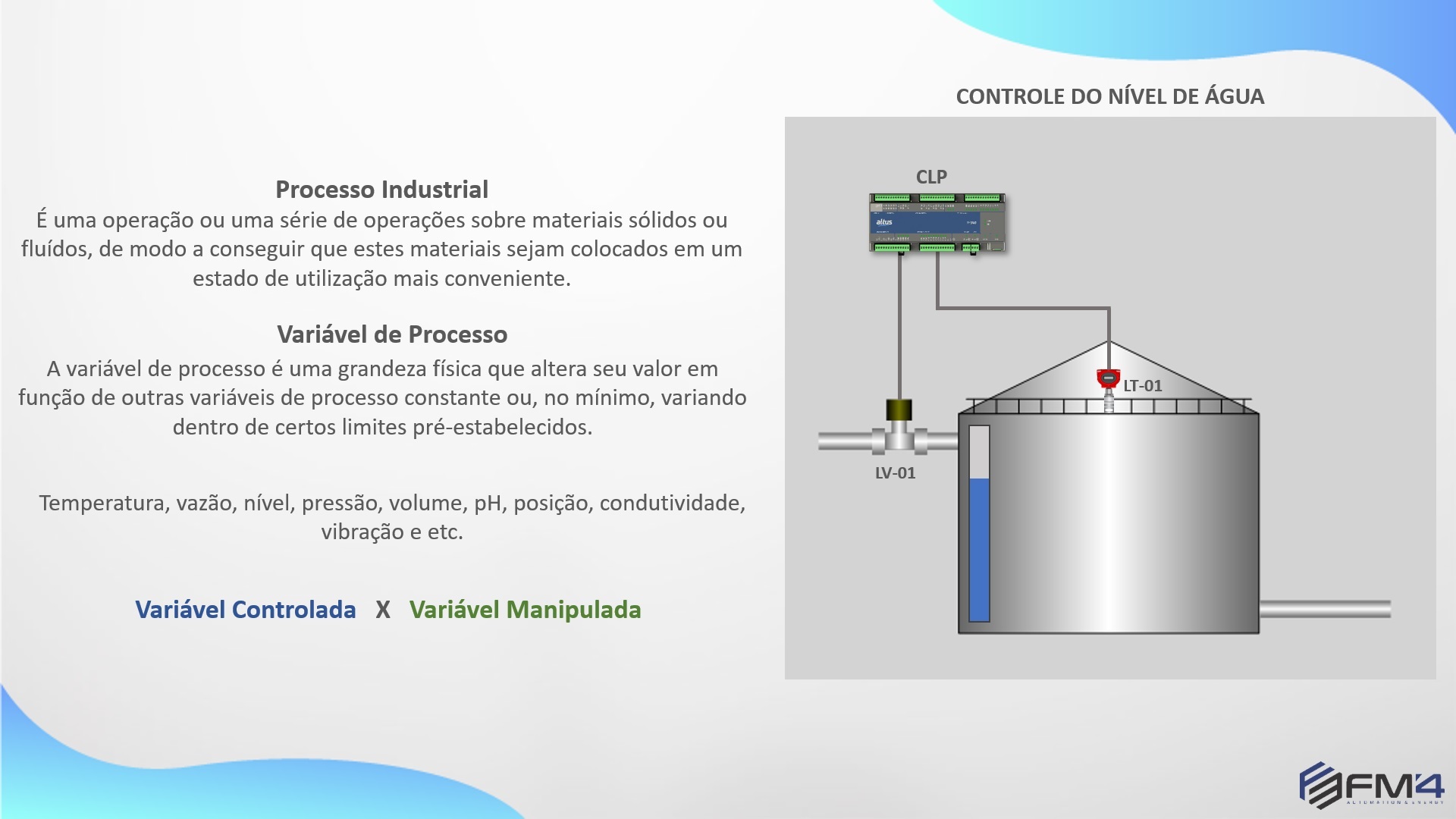
When we control a process, we come across two terms: the controlled variable and the manipulated variable. So, what are these variables?
By definition, the controlled variable of a process, also known as the process variable (PV), is the variable we want to keep within certain predetermined parameters or values. For example, in a water heating process, the controlled variable can be the water temperature, which we want to keep at a constant value or within an acceptable range.
The manipulated variable of a process, also known as the actuating variable (MV), is the variable on which the automatic controller acts in order to keep the controlled variable at the desired value. For example, in a water heating process, the manipulated variable can be the heater power, which the controller can increase or decrease depending on whether the water needs to be heated or cooled.
Therefore, the controller acts on the manipulated variable in order to control the process variable, that is, the controlled variable.
To better understand the relationship between the controlled and manipulated variables, let's use an example of water level control in a tank. Here we have a closed control loop, which is a control system that has the three main control elements: the sensor, the controller and the actuator. The sensor is the device that measures the controlled variable and sends a signal to the controller. The controller is the device that compares the sensor signal with the desired value (setpoint) and sends a signal to the actuator. The actuator is the device that receives the signal from the controller and acts on the manipulated variable.
The goal of this control is to keep the water level in the tank at a constant value or within an acceptable range. So, based on this process, we can say that:
Summing up this control loop in detail, we can say that:
Industrial process control is a field that aims to keep process variables within certain established limits, ensuring the efficiency, quality and safety of production. To do this, you need to know and control the controlled and manipulated variables of each process, which are, respectively, the variables we want to maintain and the variables we can act on. The relationship between the controlled and manipulated variables is established by a control system, which can be made up of a sensor, a controller and an actuator.
// keep reading
Find out what the MQTT protocol is, how the publish/subscribe model works and why it is essential for IoT and industrial automation in Industry 4.0.
The industrial Automation Pyramid is a visual representation that organizes the different layers of systems and technologies used to automate industrial processes.
PLC stands for “Programmable Logic Controller”. It is an electronic device used to control machines and industrial processes.
// from article to practice
In FM4 courses you program PLCs and SCADA systems hands-on, with step-by-step lessons and instructor support.